Emily M. Gordon

home | research | media | publications
Research
Pacific Ocean Variability and Predictability
Large scale variability in the Pacific Ocean on decadal timescales is dominated by the canonical Pacific Decadal Oscillation (PDO), or the Interdecadal Pacific Oscillation (IPO) if your tastes prefer. However, neither definition of variability in the Pacific Ocean is a “true” mode of variability but rather a combination of oceanic and atmospheric mechanisms operating across time and spatial scales. I am interested in methods for extracting predictable aspects of Pacific variability, including transitions in PDO phase, and coherent, domain-spanning predictable Pacific variability.
Methods for Identifying Predictability
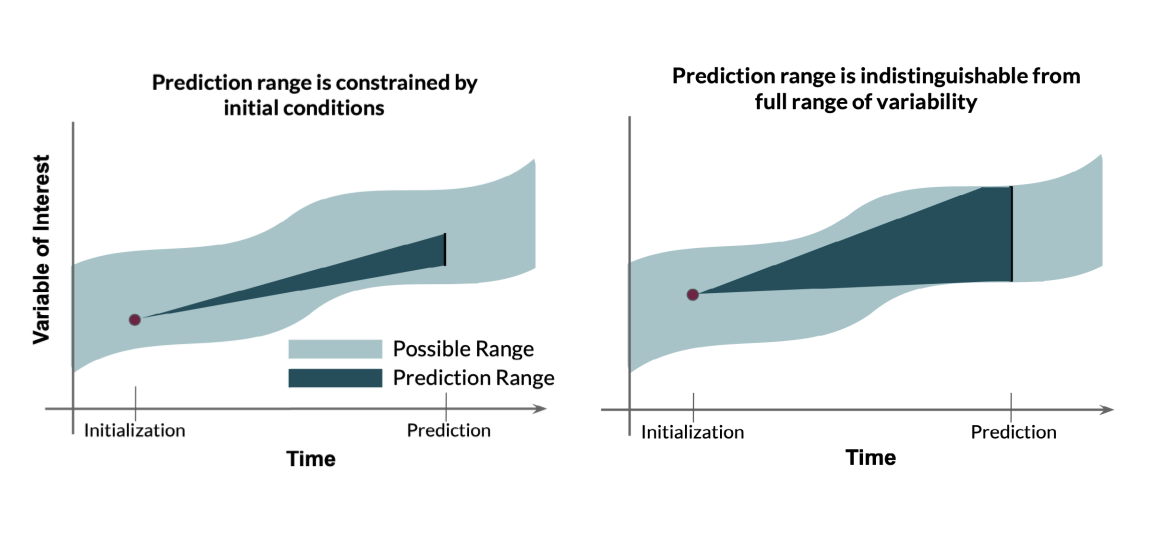
Researching Earth system predictability allows us to identify times and places within our Earth system where we can be more sure about future variability and change, and hence be better prepared for potential climate change. I am interested in combining climate model and observational data,
machine learning, and traditional statistical methods for identifying predictability to learn about predictable signals within our Earth system, and where and when we can use predictability to constrain estimates of future change.
Future Regional Climate Variability
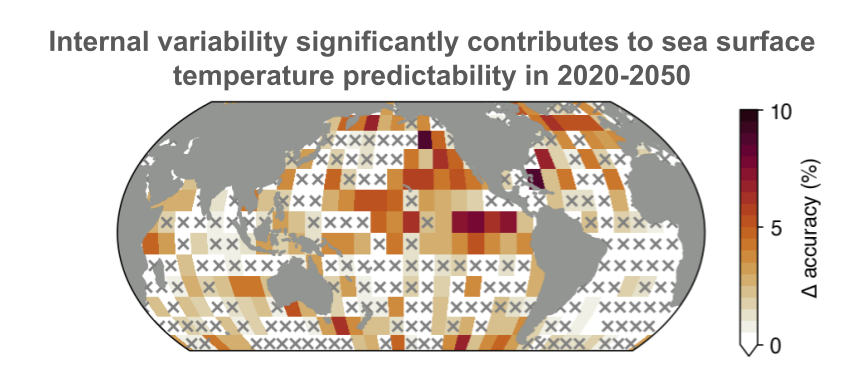
Observed climate variability is the combination of processes that are internally generated within the climate system, and anthropogenic climate change. Forced climate change is becoming more and more obvious on regional scales, amplifying internal variability to cause increases in extreme events and long term warming trends. I am interested in quantifying the relative roles of internal variability and the forced response to climate change, how this affects near term predictability of climate variability, and also how state-dependence manifests within this mess.
AI methods in climate science
My research uses data science methods to learn about the climate system from existing data sources, both observational and simulated. With the increasing role of AI within climate science, I am continuing to incorporate new methods into my research as long as they prove to be the best tool for the job. I am also interested in verifying and adapting AI-based climate emulators and developing techniques to combine with existing data sources to quickly generate estimates of future climate variability under different boundary conditions.